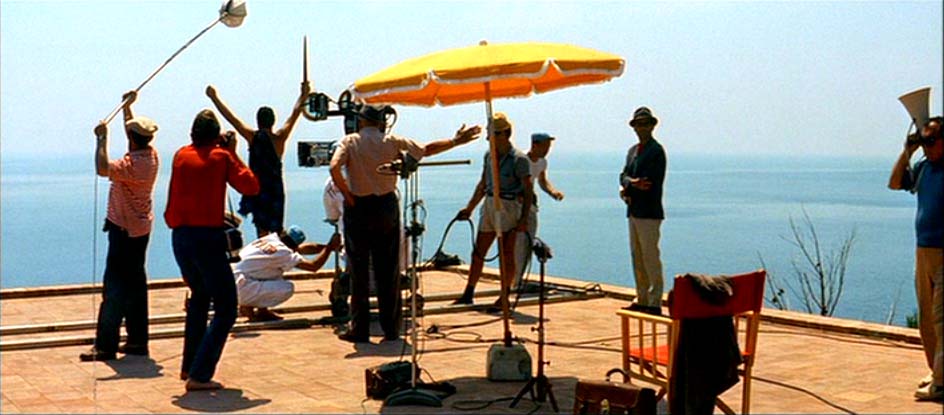
La Nouvelle Vague. Ah! Jean-Luc Godard is probably the best known director that emerged from the French new wave and with good reason, his works are thoroughly original. Parts romantic, provocateur, radical and just plain pretentious, Godard defined an entire era of film-making. They say that nothing could be the same after The Birth of the Nation. The same could be said for Godard's 1960 masterpiece À bout de souffles (Breathless.) There was a certain playfulness in that early masterpiece that's sorely missed in his later work. However, most of it is interesting and, at least, worth watching if only for purely historical reasons.

Breathless (1960)
Some films that are considered masterpieces feel stilted to modern audiences. However, this is not the case when it comes to Jean-Luc Godard's 1960 masterpiece. Breathless still has lots of charm and wit to spare. One thing I've noticed about Jean-Luc Godard is that as he made more and more films, he became more and more pretentious. But, hey, Jhon, isn't that the point? Don't we like him because he's a pretentious douche? Well, yes, but in Breathless, his doucheness hadn't overtaken him completely. It was there in an endearing way that's charming instead of annoying.


A Woman is A Woman (1961)
Godard's great homage to the American musical is also his best film. Anna Karina shines (as usual) as the world's most idealistic and beautiful striptease artist. Surrounding her are the great Jean-Paul Belmondo (from Breathless.) There is something beautifully reflexive and fun about this movie. Perhaps it's because of the way it references other films from the New Wave so gleefully and without concern such as when Belmondo says he has to leave soon because they'll be showing Breathless on TV soon and characters from other new wave films show up as well. Karina and Belmondo practically wink at the camera! Also of note is the way the score is used. It doesn't synchronize with the film in the way that you think it would but rather seems to work like an aural light bulb going off in Karina's head. How lovely and fun this movie is.
 My Life to Live (1962)


I'm seeing that Godard had two modes. He was either fun or he was boring. That's how I see it. Luckily, Band of Outsiders falls in the "fun" category. You see, this film has both "a girl and a gun." That's all you need to make a movie, after all. Godard takes these simple building blocks and then has them collide with his love of American gangster movies to create something entirely new. And, oh! "The Dance" is one of the greatest scenes in all cinema and was a direct inspiration for the Mia/Vincent dance scene in Pulp Fiction. The best thing about the film though is Karina. That goes without saying though. She's easily the best part of any movie.


 My Life to Live (1962)
It's possibly Jean-Luc Godard's most touching film and yet it's still more interesting than actually good. There is no real plot to speak of -- the film is split up into 12 chapters that more or less tell you what will happen during them. However, that's not really important either. It's all about Karina's face. Think of the famous scene where she goes to a theater to watch The Passion of Joan of Arc (a film I still haven't seen) and Godard juxtaposes Maria Falconetti's face with Karina's face as she cries. It's the best moment of the movie for a reason. Now if the rest of the movie was that good.
Le Petit Soldat (1963)
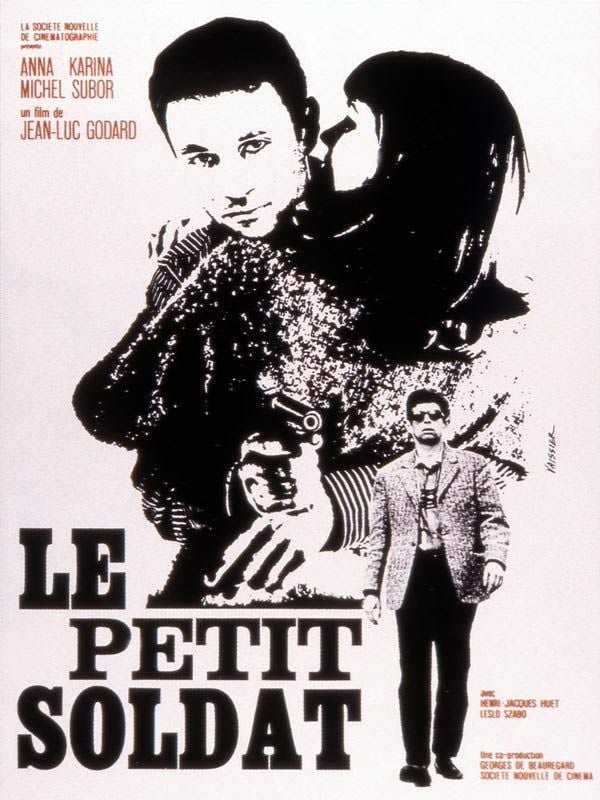
Mostly remembered as "Oh, yeah, that Godard film about the Algerian war, right?"Le Petit Soldat is a mostly unsatisfying Godard film about the Algerian war. Wait, what? It's mostly unremarkable except for the breathtaking torture sequence which even thinking about it gets me uncomfortable. This sequence should be recognized as one of Godard's greatest moments. Also notable is, of course, Karina, who can do no wrong in my eyes. Well, at least, when she's with Godard.


Les Carabiniers (1963)
I'm never really troubled when my opinion differs from the consensus. After all, it's all subjective so why should I be troubled if my reaction to a film is different than the norm. However, when it comes to Godard, if I don't like one of his films should I assume its because they went over my head? I don't think much went over my head in Les Carabiniers but, still, I don't enjoy it. Godard may have created an effective anti-war film but he's also created an impossibly dull one. In contention for one of the worst movies I've ever seen. Also, fuck the montage. A single redeeming scene does not make the movie good.

Contempt (1963)
Godard's examination of a failing marriage and the compromise between commerce and art that we affectually know as Contempt is a giant bore. I know we love Godard because he is indulgent and pretentious and that's fine to an extent but it is in this film that his inaneness comes through the most. What are we to make of the lengthy opening scene where Brigitte Bardot (mostly naked) and Michel Piccoli sit in a bed lounging about as he reassures her that, yes, he really does love her nipples all whilst the color filter changes to the colors of the French flag. Now, don't get me wrong, I like this scene. Why? Because it's so cheerfully (that's how I read it anyway) pretentious and stupid that I can't help but fall for it. Why does Godard do anything? Because he can. Godard is daring and attempts many things (for no clear purpose) but rarely does anything he attempts actually make the film better. The credits are read out loud at the very beginning instead of being shown and then the camera is turned directly to the audience. Why? To remind me that I'm watching a film? How Brechtian of you! The actors are all fine, I suppose. They aren't given much to do other than expound Godard's idea of what intellectual speech sounds like. Bardot is beautiful, Piccoli cloying, Palance hilarious (Americans do not appreciate art, what?) and Lang comes out the sorriest because he's the one that has to say all of Godard's film theories.
One thing must be mentioned: Georges Delerue's beautiful score (although hilariously misused) deserves to be sought out. It truly is a beautiful piece of work. Also pretty cool is the Naked City cover of the main theme.
One thing must be mentioned: Georges Delerue's beautiful score (although hilariously misused) deserves to be sought out. It truly is a beautiful piece of work. Also pretty cool is the Naked City cover of the main theme.
Band of Outsiders (1964)
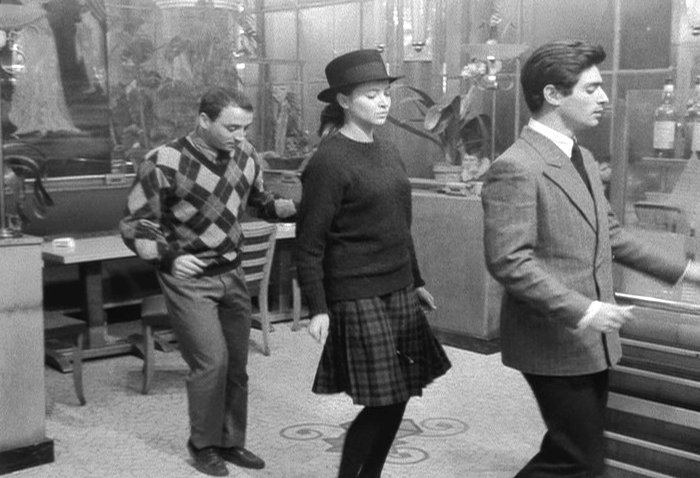
I'm seeing that Godard had two modes. He was either fun or he was boring. That's how I see it. Luckily, Band of Outsiders falls in the "fun" category. You see, this film has both "a girl and a gun." That's all you need to make a movie, after all. Godard takes these simple building blocks and then has them collide with his love of American gangster movies to create something entirely new. And, oh! "The Dance" is one of the greatest scenes in all cinema and was a direct inspiration for the Mia/Vincent dance scene in Pulp Fiction. The best thing about the film though is Karina. That goes without saying though. She's easily the best part of any movie.

Alphaville: une étrange aventure de Lemmy Caution (1965)
Godard's dazzling mish-mash of sci-fi conventions and film noir elements makes for some inspired cinema. If anything else, I've never seen anything quite like it. Of course, when you read sci-fi, you start thinking of aliens and futuristic cities and the like but, of course, Godard is Godard and those sort of things just don't fit with him. Think of it more as "Fahrenheit 451" (curiously, made into a film by Truffaut), because there is nothing overall "sci-fi" about it. When Lemmy Caution goes out into the streets, it looks exactly like contemporary French night life. It is only because of the dialogue and some of the sets that this is considered a sci-fi film. Godard once again works within the confines of a genre picture but is creative enough that a film is still like nothing I've ever seen before. That's probably his greatest talent. He takes what was once old and tired and gives it the old Godard makeover to where you're scratching your head wondering what kind of film you're watching.

Plot always comes second in Godard films. It's usually never interesting. What draws us to his films is his style. Well, I'm glad, sort of, to report that Godard remains mostly the same here. This time the only difference is that the film takes the shape of a road movie. Mostly improvised, the film is loose, unpredictable and fun. I mean, seriously, if you saw the ending of this film coming, well, you get a cookie. If anything, the film's biggest accomplishment is not being a gigantic bore ala Contempt/Weekend/Tout va Bien. That and possibly capturing Karina at her most beautiful.


Pierrot le fou (1965)
Plot always comes second in Godard films. It's usually never interesting. What draws us to his films is his style. Well, I'm glad, sort of, to report that Godard remains mostly the same here. This time the only difference is that the film takes the shape of a road movie. Mostly improvised, the film is loose, unpredictable and fun. I mean, seriously, if you saw the ending of this film coming, well, you get a cookie. If anything, the film's biggest accomplishment is not being a gigantic bore ala Contempt/Weekend/Tout va Bien. That and possibly capturing Karina at her most beautiful.

Masculin, Feminin (1966)
Is this what happens when Jean-Luc Godard reflects on the damage he's made? And by damage, I mean, the influence that he's had on 60's French youth culture. Surely, no other director influenced the youth of France so much... Jean-Pierre Leaud (Antoine Doinel any other day) even tries to do the cigarette flip thing made famous by Belmondo! The Yé-yé singer Chantal Goya also stars as his capricious girlfriend who's more interested in her own singing career than in radical politics like "Antoine." I'm lukewarm on this one. I love the idea of Godard examining the culture he's helped spawn more than the final product itself. Here's the thing about Godard that I've been noticing as I go through these films, the majority are films that you appreciate intellectually. You get what Godard is doing and you smile and you nod your head in appreciation but that's it. You're not touched, you're not moved and you're certainly not changed; you're trying to figure out what Godard is doing and why. His films are packed with style and that's all very nice but I require something more, something more personal.
We went seeking greatness in movies, and were most often disappointed. We waited for a movie like the one we wanted to make, and secretly wanted to live.
That's what this movie should be. It's too bad it isn't.
"This film could be called The Children of Marx and Coca-Cola."
He might be giving them too much credit.
We went seeking greatness in movies, and were most often disappointed. We waited for a movie like the one we wanted to make, and secretly wanted to live.
That's what this movie should be. It's too bad it isn't.
"This film could be called The Children of Marx and Coca-Cola."
He might be giving them too much credit.

Weekend (1967)
The last of Godard's golden age of cinematic output is ANOTHER bore. Though this time, it's a shockingly destructive bore. Basically, Godard hates the bourgeoisie while, in turn, they love him so he has to lash out. How does he do this? By making an incredibly boring film. Not even cannibals could wake me from my slumber! The only thing really striking about this film is its incredibly long traffic jam sequence that thrills to this day thanks to its audacity. Plus the soundtrack is all horns but no one's honking!!!

Tout va Bien (1972)

Tout va Bien (1972)
There's a reason why most of Godard's output post-1968 remains untouched, it's horrendous. Film is no longer entertainment. Instead, it is the medium where Godard's theories and ideals can be shoved down the throat of anyone who dares watch one of his films. The film is humorless, lifeless and devoid of any element that would make it thought-provoking. Godard wanted to rally the masses around his Marxist/Maoist? (who cares!) ideals but they rightfully stayed home.
I do not argue that there isn't a place for radical politics in cinema. It's just that the way Godard goes about it is pretentious, boring and meaningless.
Some thoughts:
- I do not enjoy films that I would have to go to film school to understand.
- If these films weren't in French they'd probably be unbearable.
- Truffaut is a better filmmaker than Godard in every single way.
I'm done with Godard. I'll come back to a couple of these in a few years and see how they age but a couple of these are unbearably bad. I tried to make some of my thoughts more coherent but I just want to be rid of this guy. I spent too much time on this.
Godard ranked:
1. A Woman is a Woman ★★★★
2. Breathless ★★★★
3. Band of Outsiders ★★★1/2
4. Pierrot le fou ★★★1/2
5. Masculin Feminin ★★★
6. My Life To Live ★★1/2
7. Alphaville ★★1/2
8. Contempt ★★
9. Weekend ★★
10. Le Petit Soldat ★1/2
11. Les Carabiniers ★
12. Tout va Bien ★
After Alphaville they stop being good.
I do not argue that there isn't a place for radical politics in cinema. It's just that the way Godard goes about it is pretentious, boring and meaningless.
Some thoughts:
- I do not enjoy films that I would have to go to film school to understand.
- If these films weren't in French they'd probably be unbearable.
- Truffaut is a better filmmaker than Godard in every single way.
I'm done with Godard. I'll come back to a couple of these in a few years and see how they age but a couple of these are unbearably bad. I tried to make some of my thoughts more coherent but I just want to be rid of this guy. I spent too much time on this.
Godard ranked:
1. A Woman is a Woman ★★★★
2. Breathless ★★★★
3. Band of Outsiders ★★★1/2
4. Pierrot le fou ★★★1/2
5. Masculin Feminin ★★★
6. My Life To Live ★★1/2
7. Alphaville ★★1/2
8. Contempt ★★
9. Weekend ★★
10. Le Petit Soldat ★1/2
11. Les Carabiniers ★
12. Tout va Bien ★
After Alphaville they stop being good.